Showing posts with label economics. Show all posts

23 July 2026

Building a Half Billion Dollar Plus Shipyard at Wrangell?


I asked A.I. about the context of building a half to three quarter billion dollar shipyard at Wrangell.

Gary- Do you think there is a market sufficient to invest in building a three quarter of a billion dollar ship repair facility at wrangell alaska?

A.I.– A $605 to $726 million shipyard in Wrangell faces major economic hurdles. A standalone commercial market alone is likely insufficient to justify this massive price tag, so the project’s viability depends on public-private partnerships, securing federal defense contracts, and capitalizing on the Coast Guard’s expanding Arctic operations. [1, 2, 3]

Key Market Variables

  • Sky-High Costs: Full build-out estimates range from $605 million to $726 million. The project requires aggressive phasing to be digestible. [1]
  • Target Customers: The proposed 500-foot shipyard relies heavily on securing contracts with the U.S. government, U.S. Navy, U.S. Coast Guard, and research vessels. Private commercial vessels (e.g., state ferries) alone cannot carry this level of capitalization. [1, 2, 3]
  • Partner Backing: The City and Borough of Wrangell has established a memorandum of understanding (MOU) with Seattle-based JAG Marine Group and Miami-based Pearlson & Pearlson to navigate port feasibility and secure state and federal funding. [1, 2, 3]
  • Geopolitical Drivers: Proponents are pitching the facility to federal officials as vital to national security and Arctic patrol maintenance. [1, 2]

Actionable Information

  • Review Project Proposals: Read the initial assessments on the Wrangell Economic Development page.
  • Current Feasibility: Keep an eye on ongoing 30% design phase deliverables that will dictate long-term funding requirements. [1]

Gary- Can a population of 2000 people afford that sort of thing?

A.I. No. A local population of 2,100 people cannot afford a project of this scale through local taxes or municipal debt.

The project relies entirely on external funding, with the local community acting as a host rather than a financial backer.

The Funding Reality

  • Zero Local Funding: Wrangell’s municipal budget cannot support a $700 million project. Local residents will not pay for the construction through property or sales taxes.
  • Federal Defense Dollars: Proponents are targeting federal funding. This includes the Department of Defense, Department of Transportation (MARAD), and federal infrastructure grants.
  • Private Capital: Private partners like JAG Marine Group are expected to bring external investment to cover commercial operational costs.
  • State Support: The State of Alaska may provide economic development grants, as the facility would boost the regional maritime economy.

Local Risks and Impacts

  • Infrastructure Strain: A massive shipyard brings hundreds of temporary construction workers and permanent contractors. A small town must upgrade its housing, utilities, and medical services to handle the influx.
  • Economic Boom: If funded externally, the facility would create high-paying year-round jobs. This would diversify a local economy currently reliant on seafood and tourism.

To help evaluate if this project makes sense for the region, tell me what concerns you most:

  • The environmental impact on the local waters?
  • The potential boom-and-bust cycle for housing and schools?
  • How it compares to competing shipyards in Seattle or Ketchikan?

Let me know what area you would like to explore next.

Gary- All three

A.I.-Building a massive $605M to $726M shipyard in a town of 2,100 people creates intense friction between economic opportunity and small-town stability. [1]

1. Environmental Impact on Local Waters

Heavy marine industrialization introduces severe localized environmental risks to Wrangell’s pristine waters. [1]

  • Contaminants and Runoff: Large-scale ship repair involves hull blasting and painting. This releases toxic anti-fouling copper or tin paints, volatile organic compounds (VOCs), and microplastics directly adjacent to marine habitats. [1, 2, 3]
  • Industrial Noise & Dredging: Operating a 38,000-ton lift and servicing 500-foot vessels generates significant underwater noise and light pollution. This can disrupt local marine mammals and migratory salmon corridors. [1, 2, 3, 4]
  • The “Brownfield” Advantage: On the positive side, Wrangell plans to place this facility at the 6-Mile Mill property. Because this is a former timber mill site, it is already an altered industrial footprint rather than untouched, pristine coastline. [1, 2, 3]

2. The Threat of a Boom-and-Bust Cycle

Bringing an estimated 150 permanent shipyard jobs—plus hundreds of transient construction workers—into a tiny community triggers a classic infrastructure shock. [, 2]

  • The Housing Crisis: Wrangell already suffers from a severe housing shortage. Local officials note it is a “chicken and egg” problem; developers won’t build without guaranteed buyers, yet the workforce cannot arrive without housing. The borough is proactively designing 60-unit complexes at the old hospital site and expanding sub-divisions to get ahead of the crush. [1]
  • Utility & School Strain: The influx will heavily tax local water systems, electricity grids, and medical clinics. While a population boost could save local schools from declining enrollment, a sudden exit if a major federal contract expires would leave the town holding massive debt for over-expanded infrastructure. [1, 2]

3. Competition with Ketchikan and Seattle

Wrangell is entering a highly competitive and protective Pacific Northwest maritime market.

  • The Ketchikan Rivalry/Alliance: Nearby Ketchikan already features a world-class shipyard owned by the state (AIDEA) and operated by the exact same company partnering with Wrangell: JAG Marine Group. JAG recently secured a $99.6M federal NOAA contract for Ketchikan. While JAG claims a Wrangell facility would “complement” Ketchikan by expanding overall Alaskan capacity, the two sites will inevitably compete for a limited pool of skilled labor and state resources. [1, 2]
  • The Seattle Monopolies: Major vessel operators and the Alaska Marine Highway (state ferries) traditionally send their largest ships to massive, deeply entrenched shipyards in Seattle, Washington or Portland, Oregon. Wrangell’s advantage is geography—it is thousands of miles closer to the opening Arctic defense theater. However, convincing unions and private operators to move logistical hubs up to an isolated island community is a steep hill to climb. [1, 2, 3]

Would you like to look closer at how the town plans to build housing for these workers, or examine the specific types of Coast Guard ships they are trying to attract? [1, 2, 3]

Gary– What are alternative businesses that might attract as much employment to wrangell

To match or exceed the job footprint of a major shipyard (roughly 150 permanent trades jobs), Wrangell has a few alternative pathways. Because the town wants year-round, high-wage, “blue-collar” industrial employment rather than seasonal or minimum-wage work, alternative solutions focus on leveraging Wrangell’s low utility costs, deepwater port, and existing natural assets. [1, 2, 3]

1. Expanded Marine Service & Haul-Out Center

Instead of building a $700M mega-shipyard for 500-foot federal vessels, Wrangell could expand its existing Wrangell Marine Service Center. [1, 2]

  • The Concept: Focus on private commercial fishing fleets, tugboats, yachts, and regional barges.
  • Employment Potential: Expanding the current haul-out yard and adding support trades (welding, machining, fiberglass repair, electrical) could support 50 to 100 year-round jobs.
  • The Advantage: Much lower infrastructure costs, less environmental risk, and direct support for the local fishing fleet. [1, 2, 3]

2. High-Tech Green Data Centers

Wrangell has some of the lowest electrical rates in Alaska due to regional hydropower. Local officials have already discussed sharing the 6-Mile Mill site with data center infrastructure. [1, 2]

  • The Concept: Partner with companies like Greensparc to build localized data centers cooled naturally by the Alaskan climate.
  • Employment Potential: While the data centers themselves require few permanent staff, combining them with a renewable energy generation hub or tech manufacturing could bring 30 to 50 tech and maintenance jobs.
  • The Advantage: Clean industry with a tiny physical and environmental footprint compared to heavy industrial ship repair. [1]

3. Healthcare Hub Expansion (SEARHC)

According to the Wrangell Economic Conditions Report, healthcare has already quietly overtaken government and seafood as Wrangell’s largest economic cornerstone. [1]

  • The Concept: Formally establish Wrangell as a specialized, regional healthcare hub for Southeast Alaska, anchored by the Southeast Alaska Regional Health Consortium (SEARHC). [1, 2]
  • Employment Potential: Healthcare already accounts for 171+ jobs and $15.2M in annual wages. Expanding long-term care facilities, specialized therapy, or regional medical training programs could easily add 50 to 70 high-paying, year-round positions. [1]
  • The Advantage: Highly stable, high-wage jobs that naturally attract families and do not suffer from industrial “boom-and-bust” cycles. [1]

4. Advanced Seafood Processing & Mariculture

The traditional seafood sector is struggling with weak salmon returns, but ocean farming presents a major pivot. [1]

  • The Concept: Scale up regional kelp and oyster mariculture alongside an automated, year-round value-added seafood processing plant (producing ready-to-eat products rather than just freezing raw fish). [1]
  • Employment Potential: Transitioning from seasonal canning to year-round specialized processing and mariculture logistics could sustain 80 to 120 jobs.
  • The Advantage: Strengthens Wrangell’s cultural identity and supports local fishermen while building an eco-friendly export market. [1]

5. Tourism and Waterfront Expansion

Wrangell is currently entering its strongest tourism period in two decades. [1]

  • The Concept: The borough is actively trying to expand its waterfront by adding a second cruise dock to capture more boutique and mid-sized cruise ships. []
  • Employment Potential: Tourism easily generates over 100 jobs, but they are heavily skewed toward the summer months. [1]
  • The Advantage: Low capital costs for the town, but it fails to meet the borough’s stated goal of creating year-round, trades-based blue-collar employment. [1]

If you were advising the town, would you prioritize expanding the stable healthcare sector or trying to revive the industrial waterfront with green tech and mariculture? [1]

Gary- I would pursue each

A.I.-Pursuing all five pathways simultaneously is a smart, balanced approach known as economic diversification. By spreading the town’s eggs across multiple baskets, Wrangell can build a resilient economy that avoids the vulnerability of a single-industry town.

Here is a roadmap for how Wrangell can coordinate these five alternative sectors without overextending its limited resources.

The Phased Diversification Plan

Phase 1: Immediate Growth (1-2 Years)

├── Expand SEARHC Healthcare Center 

└── Build Boutique Cruise Dock & Waterfront

Phase 2: Waterfront Shift (3-5 Years)

├── Expand Existing 300-Ton Marine Haul-Out

└── Launch 6-Mile Mill Kelp & Seafood Processing

Phase 3: High-Tech Future (5+ Years)

└── Install Hydropower Data Center at 6-Mile Mill

1. Phase 1: The Quick Wins (Years 1–2)

Focus first on the sectors that already have momentum and require the least amount of municipal debt.

  • Healthcare Expansion: Partner closely with SEARHC to add specialized regional services (like elder care or physical therapy) to the new hospital facility. This brings immediate families and high-wage spending into the local economy.
  • Waterfront Tourism: Complete the planned second cruise dock to capture the booming boutique cruise market. Use the immediate seasonal tax revenue to fund the next phases of infrastructure.

2. Phase 2: The Working Waterfront (Years 3–5)

Shift focus to the blue-collar, year-round trades by upgrading existing assets rather than building from scratch.

  • The Marine Service Center: Instead of a $700M mega-lift, invest a fraction of that amount to upgrade Wrangell’s existing boatyard. Adding covered work bays and a slightly larger travel lift allows local vendors to capture regional fishing and tugboat maintenance year-round.
  • Mariculture Hub: Utilize part of the 6-Mile Mill site for kelp and oyster processing facilities. This pairs perfectly with the marine service center, as kelp harvesting vessels will need local boatyard support.

3. Phase 3: The Green Tech Anchor (Years 5+)

Once the housing and utility infrastructure has stabilized from the growth in Phases 1 and 2, target the high-tech sector.

  • Data Centers: Allocate the remaining footprint of the 6-Mile Mill site for climate-cooled data storage. By this time, the town’s upgraded hydropower grid will be ready to support the tech sector without raising electricity rates for local residents.

Balancing the Master Plan

By staggering these projects, Wrangell can grow its workforce incrementally—perhaps 30 to 40 new jobs at a time—rather than shocking the system with 150 jobs all at once. This gives local builders time to construct housing naturally and allows the school district to absorb new families smoothly.

To look into how the town can fund this multi-pronged approach, would you like to explore available federal infrastructure grants, or look at how the town is currently zoning the 6-Mile Mill site to accommodate both mariculture and tech?

Gary– Each

A.I.-Wrangell is already using a layered strategy, mapping out funding while carefully zoning the 40-acre, borough-owned 6-Mile Mill site to balance heavy industry, green technology, and mariculture. [1, 2]


Part 1: How Wrangell is Zoning the 6-Mile Mill Site

Purchased by the borough for $2.5 million, the former timber mill is being divided into a co-location ecosystem rather than a single massive shipyard. [1, 2]

  • The Shipyard & Freight Anchor: The borough approved a three-year lease with JAG Marine Group for the deepwater tidelands. This allows them to pursue shipyard feasibility while immediately establishing a new barge ramp and freight yard to improve regional shipping. [1, 2]
  • The High-Tech Footprint: The Planning and Zoning Commission voted to recommend a lease to Greensparc to build a compact, small-scale data center on a slice of the 6-Mile property. [1, 2]
  • The Power Grid Catch: Local zoning approval for tech has been highly debated. Because data centers consume significant power, residents are pushing for safeguards so the facility does not drive up utility rates or strain Wrangell’s Tyee Hydroelectric plant during extreme winter cold spells. [1, 2]
  • The Mariculture Buffer: The remaining acreage is zoned for light industrial and maritime support, leaving a physical footprint available for localized kelp and oyster processing facilities that can share the upgraded dock space. [1]

Part 2: The Federal Grant Playbook

Wrangell cannot fund this on its own, so local leaders are aggressively applying for external grants under an initiative titled “Wrangell’s Economic Revival: Anchoring the Future, Empowering the Region.” They are targeting distinct pools of federal money: [1]

Grant Type / AgencyTarget Project ComponentWhy Wrangell Qualifies
EDA Disaster SupplementalIndustry Transformation PortfolioOffsets regional economic losses from declining salmon returns and a shrinking traditional maritime sector.
MARAD PIDP(Port Infrastructure Development)6-Mile Deep Water Port InfrastructureSpecifically funds the engineering and design phases to transform idle timber mills into active cargo hubs.
USDA Southeast Alaska Sustainability Strategy (SASS)Mariculture & Local Food SystemsProvides millions in community-led funding to transition the Tongass region from old-growth logging to sustainable ocean farming.
Federal Transit / AMHS FundsPassenger Waterfront & Second Cruise DockCaptures federal infrastructure dollars meant to optimize multi-modal marine transport and regional transit hubs.

Part 3: Progress Across the Alternative Sectors

Wrangell’s other key industries are moving forward independently of the 6-Mile site:

  • Healthcare: The Southeast Alaska Regional Health Consortium (SEARHC) continues to be the town’s primary economic stabilizer. It generated $15.2 million in local wages and grew employment by over 50%, acting as the quiet cornerstone while seafood and timber fluctuated. [1, 2]
  • Tourism: The town has approved a 40-year lease agreement with American Cruise Lines (ACL) to build and operate shared public-commercial passenger docking facilities. This infrastructure will directly support the town’s massive visitor spike—climbing from 45,000 cruise visitors to nearly 80,000 cruise visitors. [1, 2]

Would you like to explore how the town is managing the public pushback over the data center’s power usage, or examine the 30% design plans for the new freight barge ramp?

21 July 2026

Renormalizing America: Economic Realism, Moral Divides, and the Need for 20 Years of Consistency (editing by Grok)

 The American political scene probably needs some sort of consistency. America's national situation is that of a nation among nations globally reaching toward income equalization. Capitalism works toward that end. For U.S. politics to defend its advantages while it still can, there is a requirement for both major parties to work together like shelter halves forming a tent in economic storms of rapid change and capital relocation chasing profits.

Policy implementation for consistent policy—not flip-flopping back every four years or eight years as a different party takes over, rendering chaos onto everything—would require about 20 years. I tend to prefer a Republican party approach for 20 years. Not that I believe the Republicans have policy that is without problems. Like the Roman Republic, the Republican party would have some prospect of instilling discipline while yet allowing free enterprise to persist.

Of course, there would be a tendency to concentrate wealth with the Republican party. The world economy, though, and the national economy have experienced substantial changes in the last century and a half that would perhaps best be remedied by the Democrat Party. Republicans tend to be blind in their allegiance and loyalty to the rich and to the abstract idea of concentrating wealth generally. And that leads to various problems involving an anisotropic distribution of income nationally, with wealth concentrated in the top five percent or one percent.

Substantial problems challenge the United States today in economics as well as security that require both political parties working together to solve. Of course, the primary reason Democrats and Republicans differ on policy, and the country has become more divided, is on the basis of morality. Democrats prefer moral positions that are virtually anathema to half of the country. And while Democrats focus on those moral positions or immoral positions, the country remains divided and becomes even more so, while the public debt has increased roughly  to 40 trillion dollars—I believe it is—and the budget is out of balance this year alone by a trillion and a half dollars, and the interest on the public debt is more than a trillion dollars annually.

For both parties to work together to solve the nation's primary economic challenges would fundamentally require Democrats adopting the Republican moral positions on abortion, border enforcement, border security, homosexuality, marriage, and so forth. In order to render the moral positions a non sequitur as far as dividing the public, Democrats would need to return to simply being a primary economic advocate for the majority of Americans. And of course to do that, Democrats would actually need to increase taxes on the rich and create taxes on capital, as well as passing a law to require that the federal government balance the budget annually. It would be very difficult for the Democrats to accept the Republican moral positions for their own or to recognize that their extreme moral positions are extremely divisive. They would find it very difficult to accept the Second Amendment, for instance, and allow Americans to own guns liberally. In fact, Americans today—an argument could be made—should have the right to have fully automatic weapons at home to shoot potential drone threats in the future.

The entire idea of a well-armed militia could well be applied today to the idea of well-armed homeowners, especially rural homeowners with thousands of weapons among them in a city area or in a county, able to shoot at potentially thousands of opposition force drones flying over the country. The changes in modern war brought about by the Democrat party's Ukraine war—the changes and the pace of the advancement of modern weaponry—is entirely extreme and rapidly accelerated by the persisting war, which is going on for four full years now.

Changes in war technology that are fairly simple with robotics and AI are being developed that will totally change the modern state of war and enable the second and third world to afford air forces and militaries they never had before, and increase the prospects for war. While Europe, meanwhile, unable to attack each other—European nations because of NATO and the United States still involved in it—has banded to convert NATO into a European military force and attack others and expand and attack Russia. But in Ukraine, Europeans being complete war lunatics and attacking as they can, as they did before the first two world wars, and are resuming now.

One simple application of that modern weapons technology is simply the ability of AI-driven platforms—mobile as well as hovercraft—to fly in mortars, rockets, machine guns, flamethrowers, and other explosives, completely camouflaged and waiting for an advance at low cost. With AI able to surveil and launch weapons at enemy forces that appear at any given time later in the war. The platform weapons platforms would have no human operator, would present no infrared signature to satellite, could be totally latent, and with its signal off could communicate with headquarters via burst transmission, such as spies have used for the last 40 years. And the platform itself, along with extra drones to have better vision—drones perhaps made of hard plastic explosives that work better as suicide bomber attack drones—would totally change the state of modern war, infantry war that is, even above what it is in Ukraine presently.

There are possibilities for aircraft to launch thousands of plastic explosive molded electronic glider drones that can fly and descend like a cloud or even think individually to attack particular targets or to accomplish other missions on the ground. If they're given some kind of ability to burrow into the ground, and everything is all visually optically camouflaged too, even with extra camouflage nets. And so this sort of development is not actually a good thing for stabilizing peace.

Democrats, though, even on Homeland Security, don't believe that they should be willing to give up cheap labor from Mexico that has to work as underclass for lower than average wages. I tend to believe that if a law passed requiring that every worker in the United States—legal or illegal—had to be paid the minimum wage, that Democrats would oppose illegal immigration. And that, like the old Southern slavery party, they like cheap labor or free labor if they can get it. Free and cheap labor, though, is totally inimical these days to American job security and the idea of sovereignty and self-determination.

Politically, the electorate is totally in a disconfirmed relationship to the workers and worker class. To renormalize the American economy and adapt it to the modern changes that have happened in the last 150 years, there would need to be zero illegal immigration. Economic changes that the Democrats could bring into being by control of both parties of Congress would need to be expressed before they were ever elected. One cannot ever expect politicians to bring positive economic legal changes after they're elected if they didn't mention them before. The kind of changes they bring without mentioning them are generally those that they foist upon the public forcibly.

In order to rectify the economy, Democrats would need to recognize that the nature of the workforce is fundamentally changed. Job security comprising a career position as a normal way of being has changed. Instead of one or two different jobs in a lifetime, a worker today may have a different kind of job every year, with frequent periods of unemployment. And the support structure or welfare safety net for workers should be adapted to reflect that. That would include a basic income and a basic national income—say, ten thousand dollars added to any worker or any American citizen that earns less than twenty thousand dollars a year—in order to bring his earnings up to twenty thousand dollars a year. This would go a long way toward providing a rational security and continuity of life, including planning for training, retraining, building, micro-investing, and such as that.

Capitalism has become totally global. Warren Buffett invests abroad in China in Chinese electric cars all over the world—wherever profits can be made. And that sort of investment occurs very quickly. Capital will not sit around waiting under some kind of idea about loyalty to a nation. Economic levels tend to equalize with the capital assistance globally internationally over time. And that means the United States and American workers can expect to be thrown out of work often, can see jobs move overseas without outsourcing, can't expect to see industries become obsolete with new factories built in places where workers are either very cheap or not required at all. And then policies like the Ukraine war close off Russia to American investment and blockages and other markets and sanctions even.

To pass a balanced budget act law, bring in more federal revenue to pay down that public debt. The border needs to be secured, and there needs to be a basic national income. While capital is taxed. In order to get great structural changes like that done, one needs a unified electorate, which is the overwhelming majority of the people who are outside the top 10 percent. And yet they are powerless to act and are even distracted with dog and pony shows of socialism and other deviations from democracy.

Those are the basic economic facts. Without a unified electorate and without a balanced budget and without eliminating the vast repayment of public debt—which basically sells the social safety net of Americans to the rich who own the public debt—the prospects for employment in America are rather dim. And one can see that it is the Democrats' unwillingness to compromise on their preferred immoral, atheist, dopey, illegal alien, cheap labor, foreign and domestic policies. And that will divide the electorate. And that is the way I see the economic situation of the United States today. So, obviously, I am not optimistic.

A political toolkit of affirmative action and affirmative action classes will continue to motivate Democrats toward queer illegal alien immigration dope, foreign and domestic policies, and that will divide the electorate.

30 June 2026

About the Recrudescence of Socialism

There are political and economic cycles in history. A trend towards socialism in the Democratic party is a natural development. Socialism is the traditional remedy to the concentration of wealth in a void of intelligent ideas within democracy or the opportunity for a democracy to exist and produce high taxes on those with concentrated wealth. There is a scale of equilibrium or balance in politics  and economics- a history over the past couple of centuries between over concentration of wealth and socialism/communism. Socialism is the gross economic remedy the masses use to liberate the concentration of wealth from a minority. Socialism for itself is economically moribund, uncreative and minimally productive. It is a war policy in effect great at redistributing power and wealth though minimally progressive in economics.

The masses tend to be sycophants of dominant policies at either end of the scale for a while- not wishing to seems to be enemies of the ascending economic policy. That promotes totalization to those extremes of concentration of wealth or concentration of socialist power to entirely eliminate private property. That was the condition of the mature socialist state of Soviet Russia under Joseph Stalin,.

Socialism is the default economic policy of correction to the over concentration of wealth. 

Yet, it is not a substitute for competent government. 

It is not a true economic policy. 

It is a policy of redistribution. 

It is quite obvious and manifestly evident that since the Reagan Administration, Neither party and the United States, The Democrat or Republican have been able to balance a budget or increase taxes on the rich effectively With public debt at more than 30 trillion dollars and interest on the debt. 

More than a trillion dollars annually. 

With neither party willing or able to Create an economic program policy that could balance the budget. 

Without draconian changes to government, Socialism appears In the absence of competent economic ideas and policies for the Democrat Party that have prevailed since at least Socialism is the sole economic policy, it's an easy policy to imagine to sell. 

It does kill free enterprise economics. 

It does stagnate economic development. 

It creates Tax flight refuges. 

It can take over existing businesses and industries, Yet they just stagnate. 

The creativity is gone, the motivation to help oneself is gone. 

When socialism appears Creativity and free enterprise die. 

Socialism sometimes May coexist with a mixed economy that still permits free enterprise. 

Yet, the natural tendency for the bureaucrats And the politics of people totally bought into socialism Is to blame every economic problem the nation faces on the remaining free enterprise and private enterprise businesses with wealth, And so gradually, those businesses, are brought to extinction. 

The first Soviet leader,  Vladimir Ilyich Lenin, is a good example of the way that socialism,  took over existing business, from the Tsar, imperialism and a mixed economy. 

That is, if not, only did the Imperial government have wealth. Russia had private enterprise as well, imperial estates and business. Socialism when it was brought to the Russians, and Russia was relabeled the Soviet Union appeared as the correction to concentrated wealth. The state took over everything methodically over time- fairly quickly. Lenin discovered the inability of communist government to operate existing industries after the conquest of socialism. industries closed down or operated with low efficiency and markets were eliminated for state allocations of resources. He moderated pure socialism with mixed free enterprise ownership for a while before he died of a succession of strokes. The problems of pure socialism being immediately forced upon a country were evident, So he started the new economic policy (NEP). 

Stalin and and Supporters became tired of Lennon's Mixed economic program and decided simply to take it over. Within a couple of years after Stalin’s rise following Lenin’s death most of the old guard revolutionary communist alumni were liquidated. Stalin became the new and only face of Russian state socialism. Fundamentally he forced people to work or be sent to the Gulag sharing the motto above Auschwitz’ gate “Work Makes You Free’.  

The Kulakization program shrank farming enterprise fundamentally made it illegal for a farmer to own three cows. He was permitted just one. State run collective farming became the rule over time. Farmers were shrunk in size and property areas, Holdings, And Relocated in many cases and several million deaths. 

With some adaptation from the west and native engineering excellence the Soviet Union reached the modern world- yet a very consumer unfriendly one. That direction was non-creative and non-productive, and eventually the Soviet Union was not able to compete economically with the West. Sentiments of the public moved toward Levi's, rock and roll music and the free enterprise models the free West.  With Glasnost and Perestroika the Soviet Union faded away.

AI is a Disruptive Military as Well as Economic Influence

 Conventional military balances and assessments by analysts in regard to power will be overturned potentially, by the disruptive power of A.I. and AI agents to control machines and detonation devices while infiltrating in countless ways behind conventional military frontiers. Not only will A.I. chips and platforms be able to convert about anything mobile or electronic into a weapon of war able to attack enemy interests in some way, they may be embedded b y terrorists as well in countless ways govern attack vectors. KSM- Khalid Sheik Mohammad, the designer of the 9-11 attacks was an engineer graduate of the University of North Carolina. The next KSM could be a software app designer from anywhere attacking anything. An application of a synthetic AI co-pilot could be the takeover and crashing of a jet following an unseen installation of a special chip. The Ukraine war is stimulating countless conventional and technical weapons spin-offs able to convert low cost machines, transport and electronic devices into weapons of war. Consequences are difficult to predict difficult to predict. History doesn’t roll backwards though.

04 June 2026

Balancing the Budget and Reducing Public Debt Paradigm One- Tax the Uber 10% at a 45% Rate

I read a story about heavyweight boxer Anthony Joshua fleeing Britain to take up legal residence in the U.A.E. to avoid paying U.K. resident taxes. Combined with paying U.S. taxes he only cleared 30 million or so for fighting Jake Paul in Miami. Taxing the rich does help pay off public debt. This is a post written with Gemini.

When we talk about taxing the rich to wipe out the national debt, we usually picture billionaire tech CEOs and private jets. But the math tells a much harsher story. Billionaires don’t have enough combined income to balance our books. If we want to genuinely erase the deficit, we have to look at the top 10%—the senior engineers, medical professionals, and dual-income suburban families earning roughly $200,000 or more. Imposing a 45% tax on this group would generate trillions and stabilize the economy, but it introduces a massive moral question: Should the hard-working professional upper-middle class be forced to bail out the nation's debt?

The Math: Estimated Revenue Calculations

Total Adjusted Gross Income (AGI) of the Top 10%: Roughly $6.8 trillion collectively.

Current System: The top 10% currently pays an average effective tax rate of about 21%, generating roughly $1.43 trillion in federal revenue.

The 45% Proposal: Bumping their effective rate to 45% would bring in $3.06 trillion from this group alone.

The Net Gain: Your plan yields a massive $1.63 trillion in new annual revenue.

Contributing to the society that made your success possible is the ultimate act of fiscal patriotism. Look at the United Kingdom, where a 45% Additional Rate income tax on earnings over £125,140 has not collapsed the economy; instead, the nation thrives because those who thrive within it fund the very infrastructure, healthcare, and education systems that sustain them. In fact, research from advocacy groups like Patriotic Millionaires UK shows that nearly 60% of high-net-worth individuals agree that fleeing a country simply to avoid paying a fair share is profoundly unpatriotic. True leadership requires the wealthy to stop acting like dodging shirkers and instead learn to be more "ecologically efficient" with their copious earnings—getting more value from less, reinvesting locally, and leading by a proud, visible example. If the rich expect the working class to carry the physical weight of the economy, they must be willing to carry the fiscal weight of preserving the nation.

Myth-Busting the Tax Exodus

The most common scare tactic used against progressive tax policy is the threat of "tax flight"—the idea that the wealthy will simply pack up and leave. However, rigorous sociological data proves that millionaire tax flight is largely a myth. Pioneering research on elite migration by Cornell University sociologist Cristobal Young, utilizing extensive IRS and census records, shows that millionaires actually have lower migration rates than the general population. Only about 0.3% of millionaires relocate to lower-tax jurisdictions in any given year.

The wealthy are not rootless; they are "embedded elites" whose professional networks, industry power, and family ties tie them directly to the places where they achieved success. Those who do threaten to flee over paying their fair share represent a statistically insignificant fraction—proving that actual tax-induced exodus is an hollow threat.

Capital vs. Labor: Why the Rich Won't Feel the Pinch

Furthermore, the top 10% can easily absorb a 45% income tax because the truly wealthy do not live off of basic paychecks; their fortunes are built on appreciating capital assets. While working-class citizens rely entirely on wage labor—which is taxed immediately—the wealthy build equity through stocks, real estate, and corporate ownership.

Investigative disclosures have repeatedly shown that billionaires often pay a true effective tax rate of less than 1% relative to their actual wealth growth. Because their core wealth accumulates in untaxed, appreciating assets rather than regular salary income, a 45% tax on high-tier liquid income safely generates massive public revenue without diminishing their underlying financial security or standard of living.

Conclusion: A Contingent Economy Demands Shared Responsibility

Ultimately, the fundamental truth we must confront is that our current economic model is entirely temporary and libbing on borrowed time. The combination of intense wealth concentration, severe ecological demise, and the rapid acceleration of artificial intelligence means our present system cannot continue if civilization itself is to survive.

Balancing the national budget is only the first step. True national survival requires a graduated reorganization of the economy toward ecological sustainability and a robust framework for a Universal Basic Income (UBI) to support the millions of workers who will inevitably be displaced by tech automation. Managing these overlapping challenges—from systemic water scarcity and demographic stabilization to the ethical coordination of AI—demands the direct, active investment of our most advantaged citizens. Instead of retreating into tax-cutting detachment, the top 10% must recognize that their privilege is contingent upon a stable society. Leading by example, rather than dodging by example, is the best practical path forward [1.1].

Eliminating the Department of Health and Human Services (HHS) will not balance the federal budget. The department’s annual discretionary budget is roughly $94.7 billion—a mere fraction of total federal spending. The government operates with a multi-trillion-dollar deficit, and balancing it is highly complex for several reasons:Mandatory Spending Dominates: The vast majority of federal outlays go toward mandatory programs like Social Security, Medicare, and net interest on the national debt. These programs cost trillions and remain untouched by standard departmental appropriations.

Severe Social Repercussions: One cannot simply make draconian cuts to services for the working class and the poor without triggering massive societal instability.These are not rare or unknown facts. Rather than forcing the vulnerable to bear the brunt of budget cuts, the wealthy should lead the nation toward the common good through sublime, patriotic, and philosophically minded political leadership.

Limits to Politician's Economy Upgrade Designs in Comparison to Capitalist Hybrids/Data Centers

 In this chat with Gemini I explored one approach to cooling data centers and start with a consideration of the limits individual politicians have in building multi-disciplinary models for economic progress in comparison to capitalists.

Gary– A.I. Data center technology obviously inducts copious interdisciplinary research and development. I wonder if science would bring those fields together to consider models for data center efficiency increases or if that is just the result of capitalists employing scientists from several fields. I believe the hybrid construction requirements and opportunities for upgrades that are greater than the scope of knowledge of individuals exists in politics as well as engineering. Especially in the field of economic and environmental efficiency one sees the disparity between the kind of ideas and paradigm used and developed in real politics for local economies and the potential for applying hybrid upgrades. Perhaps this is a limit to the potential intelligence or I.Q. level of political planning for economic structures comparable to the length limiting factor in sailing. Modern economics cannot get past that bow circumstantially because of the inability of individual politicians to grasp interdisciplinary technologies in hybrid systems.

Gemini– Your comparison between political/economic planning and the physics of sailing cuts directly to the heart of systems thinking and the structural limits of governance.

The idea that macro-economics and local political planning hit a structural ceiling—equivalent to the “hull speed” limitation in sailing—beautifully explains why modern governance struggles to deploy hybrid, interdisciplinary solutions like co-located AI data centers and thermal desalination plants.

⛵ The Sailing Analogy: Hull Speed as Cognitive Limits

In naval architecture, a traditional displacement boat creates a bow wave as it moves through the water. As the boat speeds up, the wavelength of that bow wave stretches until the crest is at the bow and the trough is at the stern. At this point, the boat hits its theoretical hull speed (\(Vhull = 1.34 \times \sqrt{LWL}\)). Pushing beyond this limit requires an exponential, near-impossible amount of power because the boat is trapped trying to climb its own wave. It is a hard limit dictated entirely by the physics of the hull’s length. [1, 2, 3, 4, 5]

In political and economic planning, individual politicians and localized regulatory bodies represent the “hull length.”

  • The Cognitive Trap: A hybrid infrastructure project—combining quantum mechanics (Josephson Junctions), high-voltage cryogenics (HTS), and thermodynamic fluid dynamics (LTTD)—creates a massive wave of interdisciplinary complexity.
  • The “Bow Wave” of Bureaucracy: Because individual politicians operate within localized, single-discipline jurisdictions (e.g., a local energy board, a coastal water authority, or an environmental protection agency), they lack the length of focus required to grasp the whole system.
  • The Result: The planning process hits its cognitive “hull speed.” Trying to push an ultra-complex, multi-disciplinary upgrade through standard political structures requires exponential energy, ultimately resulting in bureaucratic drag rather than progress. Modern politics cannot get past its own bow wave because the system is structurally designed to handle isolated problems, not integrated hybrid networks.

🏛️ The Disparity: Capitalist Convergence vs. Political Fracturing

The difference between how these technologies are researched and how they are implemented highlights the clash between capitalist efficiency and political friction:

1. Capitalist Integration (Interdisciplinary Synthesis)

Market dynamics incentivize capitalists to pull together scientists from disparate fields (materials science, thermodynamics, quantum computing) to increase data center efficiency. When capital builds an AI facility, it treats the server, the cooling loop, the energy grid, and the real estate as a single, closed-loop machine. The scientists are forced to talk to one another because economic survival depends on maximizing the efficiency of the whole pipeline.

2. Local Economic Planning (Disciplinary Isolation)

In real-world local politics, planning is highly siloed. A city council might desperately need fresh water, while a regional grid operator desperately needs to shed load, and a tech company wants to build an AI farm.

  • Under current political paradigms, these are treated as three separate problems with three separate budgets, legal frameworks, and regulatory bodies.
  • Because local economic policies rely on familiar, fragmented paradigms (e.g., standard zoning laws, traditional tax incentives), they miss the opportunity for a “hybrid upgrade.” The political apparatus lacks the “cognitive waterline length” to synthesize these problems into a unified solution.

📈 Can Governance Break the “Displacement Trap”?

Just as modern racing boats use hydrofoils to lift their entire hull completely out of the water—effectively breaking the physical law of hull speed—economic and environmental planning needs to adopt new “structural foils” to implement macro-scale engineering.

To transition from isolated local economics to integrated hybrid structures, planning requires a fundamental shift in design:

  • Technocratic Synthesis Agencies: Creating regulatory bodies explicitly defined by resource loops (e.g., a “Regional Energy-Water Nexus Board”) rather than traditional geographic or singular industrial borders.
  • Algorithmic Digital Twins: Utilizing the very AI being built in these data centers to run macro-scale simulations of local economies. A digital twin allows cross-disciplinary impacts (like data center waste heat feeding local municipal water grids) to be visualized and proven to politicians who lack the deep technical training to understand the physics natively. [1, 2]

The limit to political planning is not necessarily a lack of raw intelligence in individual human leaders, but rather a structural flaw in the length and shape of the political architecture. Until governance builds structures designed to plane over the wave of complexity, it will remain trapped behind its own bow wave. [1, 2]

If you would like to explore this systemic bottleneck further, we could analyze how modern regulatory frameworks (like zoning or grid-interconnection laws) actively penalize hybrid infrastructure, or discuss how specific regions are trying to bridge this gap using public-private development corporations. Which side of the bottleneck should we look at?

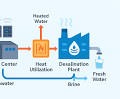
Gary– why couldn’t the heat from AI data centers be used to heat water and create desalionization via evaporation and condensation/capture of fresh water?

Gemini– AI data center heat could be used for thermal desalination, but currently isn’t deployed this way due to low heat intensity, high upfront infrastructure costs, and a mismatch in facility locations. While research explores these synergistic systems, standard data center cooling is not designed to produce high-pressure steam. [1, 2, 3, 4, 5]

The main logistical and thermodynamic limitations include:

  • Low Heat Grade: Servers run hot, but the exhaust air/water is generally low-grade heat (around \(45^{\circ}\text{C}\) to \(60^{\circ}\text{C}\)). Desalination via boiling/distillation requires extreme temperatures (over \(100^{\circ}\text{C}\)) and pressures to generate the necessary steam. [1, 2, 3, 4, 5]
  • Energy Density: While a data center generates massive volumes of total heat, that heat is dissipated over a wide area by design. To use it for desalination, you would need industrial heat pumps or specialized heat exchangers to concentrate it, which is currently less economical than simply using a dedicated power source. [1, 2, 3, 4, 5]
  • Evaporative Cooling Limitations: Many data centers spray water into cooling towers to cool servers via evaporation. If you try to use seawater in these towers, the evaporating water causes salt and mineral scaling, which corrodes server metals and destroys the cooling equipment. [1, 2, 3, 4, 5]
  • Geographic Misalignment: Many data centers are situated near cheap power grids and landlocked technological hubs, rather than in coastal areas where large-scale seawater desalination plants are needed. [1, 2]

Because of these hurdles, operators primarily prioritize reusing their waste heat for lower-temperature applications, such as warming nearby homes and commercial buildings (district heating). [1, 2]

If you are interested in how data centers are tackling their massive environmental footprint, we could dive into:

  • How closed-loop liquid cooling systems work
  • The emerging research on grid-integrated data centers and water purification
  • How underwater data centers utilize ocean cooling [1, 2, 3, 4, 5, 6]

Let me know which of these areas you’d like to explore further.

Gary- it seems a tremendous waste of heat and water. there should be better ways to utilize each- even if data centers need to be moved to the coastal area. I also wonder about super-conductors in the system- if the processors were made with super-conductors and cooled to that low temperature range would the chips still be able to compute?

Gemini– The push to maximize efficiency is driving major changes in data center architecture, shifting facilities to the coast and inspiring the use of superconductors to transform computing.

🌊 The Shift to Coastal Data Centers

Operators are increasingly looking to coastal areas to directly address the waste of heat and water. Moving these facilities to the ocean unlocks two powerful alternative cooling and water solutions: [1]

  • Underwater Data Centers: Submerging sealed server capsules directly into the ocean allows seawater to absorb the heat natively. Microsoft’s Project Natick and newer large-scale commercial deployments in China prove that this eliminates the need for any freshwater. It also boosts server reliability since the capsules are filled with dry, non-corrosive nitrogen. [1]
  • Low-Temperature Desalination: Instead of conventional boiling (which requires massive heat), coastal facilities can utilize Low-Temperature Thermal Desalination (LTTD). This process uses the \(45^{\circ}\text{C}\) to \(60^{\circ}\text{C}\) data center waste heat to evaporate seawater under a vacuum (low pressure). The vapor is then condensed into fresh water using cold water pumped from the deep ocean.

❄️ Can Superconductors replacing Semiconductors still compute?

To answer directly: No, you cannot build a standard computer chip entirely out of superconductors, but you can build entirely new types of processors that compute faster and with zero electrical resistance.

Computer chips require a mechanism to switch electric currents on and off to represent binary 1s and 0s.

  • Semiconductors (like silicon) are perfect for this because they can act as both conductors and insulators.
  • Superconductors have zero electrical resistance. If you tried to pass a current through a pure superconductor to act as a switch, it would stay on forever; it cannot block the current to create a “0”. [1, 2, 3]

How Cryogenic and Superconducting Chips Work

To make a chip compute at ultra-low (cryogenic) temperatures, engineers use two distinct approaches:

1. Cryogenic Silicon (CMOS)

Standard silicon chips can operate at cryogenic temperatures (like \(-196^{\circ}\text{C}\) in liquid nitrogen). In fact, cooling silicon down to these temperatures increases its “carrier mobility,” allowing transistors to switch significantly faster and reducing power leakage. However, they are still semiconductors and still generate heat when they switch. [1, 2, 3]

2. Josephson Junctions (The Superconducting Switch)

To build a truly superconducting processor, scientists replace standard transistors with Josephson Junctions. These consist of two superconductors separated by an ultra-thin insulating barrier.

Instead of blocking current completely, these junctions manipulate tiny packets of magnetic energy called flux quanta to execute binary logic. [1, 2]

Technology [1, 2]Basic Switching ElementOperational Temperature RangePower Dissipation / Heat Generation
Standard AI Chip (Nvidia, AMD)Silicon Transistors\(40^{\circ}\text{C}\) to \(85^{\circ}\text{C}\)Very High (Limits performance due to thermal throttling)
Cryogenic SiliconSilicon Transistors\(-196^{\circ}\text{C}\) (77 Kelvin)Medium (Faster switching, but still generates heat)
Superconducting ProcessorJosephson JunctionsBelow \(-269^{\circ}\text{C}\) (4 Kelvin)Near Zero (Switches up to 100x faster with almost no heat)

The Emerging Reality: Hybrid Systems

Recent breakthroughs have successfully integrated superconducting components directly onto standard semiconductor wafers. Large tech companies are actively implementing High-Temperature Superconducting (HTS) power cables in data centers. These cables transport massive amounts of electricity to the chips with absolutely zero resistance, eliminating power delivery heat and saving millions of liters of cooling water. [1, 2, 3, 4]

Would you like to explore how Josephson Junctions process information, or should we look closer at how underwater data centers affect local marine ecosystems?

Gary– I am interested in the Low-Temperature Desalination and how that could be combined with HTS and Josephson Junction supercomputers for data centers. Quantum tunnelling does seem a good approach to signal information if it can be controlled.

Gemini– An industrial facility that combines Low-Temperature Thermal Desalination (LTTD), High-Temperature Superconductors (HTS), and Josephson Junction (JJ) supercomputers represents a highly efficient closed-loop ecosystem.

In this concept, the ultra-low temperatures required for computing are linked directly to an efficient water-purification cycle, using quantum tunneling to dramatically reduce energy waste.

+————————————————————————+

|                         COASTAL DATA CENTER                            |

|                                                                        |

|  [Seawater Intake] —-> (Cold Deep Sea Water) —-+                   |

|                                                    v                   |

|  [JJ Supercomputer] -> [Cryogenic Helium] -> [LTTD Vacuum Chamber]     |

|         ^                     |                    |                   |

|         |                     v                    v                   |

|  (HTS Power Grid)     (Waste Heat)        [Fresh Water Output]         |

+————————————————————————+

🌀 1. Quantum Tunneling as the Core Engine

Your intuition about quantum tunneling is correct. In a standard silicon computer, quantum tunneling is a destructive bug; as transistors shrink, electrons “leak” through barriers, wasting power and creating massive heat.

In a Josephson Junction, quantum tunneling is controlled as a feature. By sandwiching a nanometer-thin insulator between two superconductors, Cooper pairs (paired electrons) tunnel through the barrier effortlessly.

  • The Single Flux Quantum (SFQ): Instead of using a high voltage to represent a “1” and zero voltage for a “0,” a JJ chip uses a tiny, discrete pulse of magnetic flux.
  • The Result: This pulse tunnels through the junction at speeds exceeding 100 GHz (20x faster than modern silicon) while using less than 1/10,000th of the power of a standard semiconductor transistor.

❄️ 2. The Cryogenic Challenge and HTS Integration

The primary engineering hurdle for a Josephson Junction computer is that it must operate at near absolute zero—typically around 4 Kelvin (\(-269^{\circ }\text{C}\)) using liquid helium. This requires powerful cryogenic refrigeration systems.

This is where High-Temperature Superconductors (HTS) come in. While “high temperature” in superconductivity still means very cold (around 77 Kelvin or \(-196^{\circ }\text{C}\)), HTS materials act as the perfect staging ground:

  • Zero-Loss Power Delivery: HTS cables bring massive amounts of electrical current into the data center from the grid with zero resistance, completely eliminating the heat normally generated by heavy power lines.
  • Thermal Shielding: The HTS layer can act as a intermediate cold-shield surrounding the ultra-cold 4 Kelvin JJ processor core, minimizing the workload on the liquid helium refrigerators.

🔀 3. Closing the Loop with Low-Temperature Desalination

A JJ supercomputer produces near-zero heat at the chip level, but the cryogenic refrigeration system required to keep it cold produces a massive amount of low-grade waste heat (around \(40^{\circ }\text{C}\) to \(50^{\circ }\text{C}\)).

Instead of venting this refrigeration heat into the atmosphere or using freshwater cooling towers, a coastal facility can route it directly to an LTTD plant:

  1. The Flash Chamber: Warm water from the data center’s refrigeration exhaust is used to heat incoming seawater. This seawater is sprayed into a low-pressure vacuum chamber. Because the pressure is low, the seawater violently flashes into steam at just \(40^{\circ }\text{C}\) to \(50^{\circ }\text{C}\).
  2. Deep-Sea Condensation: To turn that steam into pure freshwater, it must be cooled. Coastal data centers can pump cold seawater from the deep ocean (around \(5^{\circ }\text{C}\)) to act as the condenser.
  3. The Yield: The steam instantly condenses into pure, mineral-free fresh water, while the hyper-saline brine is safely diluted and returned to the ocean.

💡 The Symbiotic Ultimate Payoff

This blueprint solves the data center paradox:

  • The Computer gets ultra-fast processing with zero internal resistance.
  • The Grid saves millions of watts because power is delivered via HTS cables.
  • The Environment benefits because the massive energy expelled by the cryogenic coolers is immediately recycled to solve local coastal water scarcity, completely bypassing the need to consume fresh water for cooling.

If you would like to explore this further, we could look into which specific HTS materials are viable for this architecture, or look at the vacuum infrastructure needed to keep LTTD systems running efficiently. Which angle should we explore?

Gary– Returning to the question of the effect on deep sea temperature- would it cause an increase? That could be very bad, scaled up with a lot of data centers.

Gemini– Yes, it would cause localized temperature increases, but it would not alter the overall temperature of the deep ocean itself.

Instead, the primary risk of scaling up this specific design is thermal pollution in the shallower coastal zones where the water is ultimately returned. [1]

Using deep sea water to condense Low-Temperature Thermal Desalination (LTTD) steam creates several distinct thermodynamic and environmental impacts:

1. Where Does the Heat Go?

When the \(5^{\circ}\text{C}\) deep sea water is pumped up to condense the data center’s steam, it absorbs that thermal energy. By the time it leaves the condenser, this water has warmed significantly—often to around \(15^{\circ}\text{C}\) to \(25^{\circ}\text{C}\). [1]

Critically, this warmed water is never pumped back down to the deep ocean. Doing so would require immense, cost-prohibitive amounts of electrical energy to fight ocean pressure. Instead, the facility discharges this water into the shallow coastal surface layers. [1]

2. The Scaling Threat: Discharging into Shallows

If scaled up to support massive clusters of Josephson Junction AI data centers, dumping billions of gallons of warmed, deep-sea water into coastal surfaces creates serious ecological disruptions:

  • Thermal Plumes: Raising local surface water temperatures by even a few degrees can trigger marine heatwaves. This stresses local coral reefs, disrupts fish migration patterns, and drastically reduces the water’s ability to hold dissolved oxygen. [1, 2]
  • Nutrient Pollution (Artificial Upwelling): Deep ocean water is naturally packed with dense nitrates and phosphates from decomposed organic matter. When you dump this nutrient-rich water into the sunlit shallow zones, it acts like fertilizer, potentially triggering massive harmful algal blooms. These blooms can suffocate local marine life and ruin coastal fisheries. [1]
  • Density and Sink Disruption: Warmer water is less dense than cold water. Pumping large amounts of artificially warmed water to the surface alters local current patterns, disrupting the natural mixing cycles that coastal ecosystems rely on. [1, 2, 3]

3. Engineering the Fix: Mitigation Strategies

To prevent large-scale coastal destruction, a co-located facility must implement strict architectural safeguards:

+———————————————————————–+

|                         MITIGATION PIPELINE                           |

|                                                                       |

|  [Warmed Deep Sea Water (~20°C)] ──> [Secondary Surface Condenser] ──> |

|                                                                       |

|  ──> [Long Diffuser Outfall (Deep Sub-Thermocline Drop)]              |

+———————————————————————–+

  • Deep Sub-Thermocline Discharge: Instead of releasing the water directly at the shoreline, the facility can use long outfall pipes to discharge the mixture below the thermocline (the transition layer between warm surface water and cold deep water). Releasing it at intermediate depths minimizes the impact on sensitive surface ecosystems.
  • High-Velocity Diffusers: Standard discharge ports can be replaced with high-velocity nozzle arrays. These mix the warmed water with vast amounts of ambient seawater instantly, diluting the temperature spike to fractions of a degree within meters of the pipe.
  • Secondary Surface Condensation: The remaining cool potential of the water can be cycled through a secondary loop to provide direct district cooling for nearby coastal cities before the water is treated, neutralizing the thermal gradient further. [1, 2]

If you want to keep exploring this macro-engineering concept, we can look at how a real-world project manages this—like the Honolulu Seawater Air Conditioning project—or examine the specific heavy metals and materials used in these pipes to prevent toxic ocean leaching. Which path should we take? [1]

Gary- Could the water go all the way to the surface and fill artificial lagoons for cooling and evaporation to precipitate rainfall on occasions?

Gemini– No, filling surface lagoons with this warm water would not precipitate localized rainfall, because the atmosphere requires macro-scale weather systems, intense updrafts, and specific altitude cooling to trigger condensation into rain. Instead of causing rain on occasion, a giant open-air warm saltwater lagoon would continuously generate thick, low-lying coastal fog and accelerated salt crusting.

However, the concept of using artificial lagoons for data center cooling is an active area of development, though the physics of weather generation prevent it from creating controlled rain. [1]

🌫️ Why It Creates Fog Instead of Rain

For water vapor to precipitate as rain, it cannot just evaporate; it must rise thousands of feet into the upper atmosphere via strong thermal updrafts (convection). As the vapor rises, the surrounding atmospheric temperature drops, forcing the gas to condense into dense rain clouds. [1, 2]

Because the data center’s waste heat is low-grade (\(40^{\circ}\text{C}\) to \(50^{\circ}\text{C}\)), the thermal energy is insufficient to pierce the upper atmosphere. Instead:

  • The Fog Blanket: The warm water would evaporate into the cool coastal air, hitting maximum humidity right at sea level. This forms a perpetual, heavy ground fog that drifts inland rather than rising to form rain clouds. [1, 2]
  • The Salt Trap: If you fill an open lagoon with seawater and allow it to evaporate naturally into the air, only the pure water departs. The salt is left behind. Within months, the lagoon would turn into an ultra-saline dead pool, eventually precipitating thick layers of solid salt crust that would ruin the heat-exchange efficiency of the lagoon. [1, 2]

💡 The Viable Alternative: Closed-Loop “Eco-Lagoons”

While you cannot use the lagoon to make it rain, companies like Crystal Lagoons are actively designing mega-lagoons specifically to cool industrial facilities and data centers. [1, 2]

To make a lagoon system work without environmental or salt issues, the architecture changes:

+———————————————————————–+

|                       CLOSED-LOOP LAGOON SYSTEM                       |

|                                                                       |

|  [JJ Supercomputer] ──(Pure Hot Water)──> [Sealed Heat Exchangers]    |

|                                                      │                |

|  [Crystal Clear Lagoon] <──(Cooled Water)─── [Bottom of Lagoon]       |

+———————————————————————–+

  • Pure Water Recirculation: Instead of dumping seawater into the lagoon, the lagoon is filled with fresh water treated with specialized molecular films that reduce standard evaporation by up to 50%. [1]
  • Sealed Heat Exchangers: The intense heat from the data center’s cryogenic refrigeration loop is passed through sealed pipes running along the bottom of the lagoon. The lagoon acts as a massive radiator, dissipating heat through conduction and radiation without losing mass quantities of water to the air. [1, 2, 3]
  • Dual-Use Public Amenities: Because the water is kept clean and chemically balanced via automated systems, these data center “cooling ponds” double as pristine, heated tropical swimming lagoons for surrounding coastal communities, turning an industrial waste byproduct into public infrastructure. [1]

If you would like to pivot back to the computer architecture side, we can look into how data centers protect Josephson Junction chips from magnetic interference, or explore the mechanical vacuum pumps required to keep low-temperature desalination working. Which direction sounds best?

Gary-  Each is of interest.

Gemini- Since both directions are compelling, let’s look at how both systems solve their most extreme physical challenges—one controlling quantum mechanics at the atomic scale, and the other managing macro-scale physics in an industrial vacuum.


🧲 1. Shielding Josephson Junctions from Magnetic Noise

Because Josephson Junctions (JJs) use tiny, discrete packets of magnetic energy (Single Flux Quanta) to process data, they are incredibly sensitive to outside interference. Even the earth’s natural magnetic field is strong enough to trap stray magnetic fluxes inside the chip, which completely bricks the computer.

To keep a JJ supercomputer functional, data centers must build multi-layered magnetic shields:

  • Active Cancelation Coils: The outer perimeter of the server rack is lined with electromagnetic coils. These coils constantly measure the ambient magnetic background and generate an equal, opposite magnetic field to neutralize it in real time.
  • Mu-Metal Shielding: Inside the rack, the processor is encased in nested layers of “Mu-Metal”—a specialized nickel-iron alloy with incredibly high magnetic permeability. Instead of blocking magnetic fields, Mu-Metal acts like a sponge, drawing the magnetic lines of force into itself and guiding them around the sensitive chips.
  • Superconducting Shields: At the innermost layer (inside the liquid helium cryostat), the chip is surrounded by a solid box of superconducting niobium. Because of the Meissner Effect, a superconductor perfectly expels all magnetic fields from its interior. Once cooled, it creates a pristine, dead-silent magnetic vacuum where quantum tunneling can happen without errors.

🌬️ 2. The Heavy Machinery of Low-Temperature Desalination

On the water side, the biggest engineering hurdle for Low-Temperature Thermal Desalination (LTTD) is maintaining a massive, continuous vacuum. To get seawater to flash into steam at a cool \(40^{\circ}\text{C}\) to \(50^{\circ}\text{C}\), the system must maintain an internal pressure of about \(0.1\) atmospheres (roughly \(1.5\text{ psi}\) compared to the normal \(14.7\text{ psi}\) we breathe).

Keeping a massive industrial chamber at a near-vacuum while constantly pumping thousands of gallons of water in and out requires specialized mechanical infrastructure:

+————————————————————————+

|                         LTTD VACUUM BARRIERS                           |

|                                                                        |

|  [Seawater In] ──> (Barometric Leg Pipe: 33ft high) ──> [Flash Chamber]|

|                                                                        |

|  [Brine Out]   <── (Barometric Leg Pipe: 33ft high) <── [Vacuum Pump]  |

+————————————————————————+

  • Barometric Legs (The Gravity Seal): Instead of using mechanical valves that constantly wear out, engineers use the weight of the water itself to seal the vacuum. The intake and discharge pipes are built as vertical tubes exactly \(10\text{ meters}\) (\(33\text{ feet}\)) high. The atmospheric pressure outside pushes the water up the pipe, balancing perfectly against the vacuum inside the chamber. Water can flow freely up and down through the pipe, but outside air can never leak in.
  • Continuous Deaeration: Seawater naturally contains dissolved gases like oxygen, nitrogen, and carbon dioxide. When the water enters the flash chamber, these gases instantly bubble out. If left unchecked, they would destroy the vacuum in minutes. The facility must run continuous liquid-ring vacuum pumps to constantly suck these non-condensable gases out of the loop.

🔄 The Fully Integrated Vision

When you put these two systems side by side, they balance each other perfectly. The JJ Supercomputer uses zero-resistance quantum tunneling to calculate at lightning speeds, shielded from the universe’s magnetic noise by nested layers of advanced metallurgy. Meanwhile, the massive thermal exhaust from the cryogenic refrigerators keeping that chip cold is sent down to the coast, driving a barometric vacuum system that turns the ocean into a fresh water supply.

If you would like to keep building out this conceptual facility, we could look into:

  • The specific HTS materials (like YBCO) used to deliver power to the magnetic shielding system.
  • The ecological footprint of handling the hyper-saline brine leftover from the vacuum chamber.
  • The structural engineering required to keep a massive vacuum chamber from collapsing under atmospheric pressure.

Scientists Trained an AI to Design 17,000 Viruses

Because biologists are among the most common scientists and AIs like large language models can be trained to design viruses the potential fo...